Types of Operating System-
1. Batch operating system-
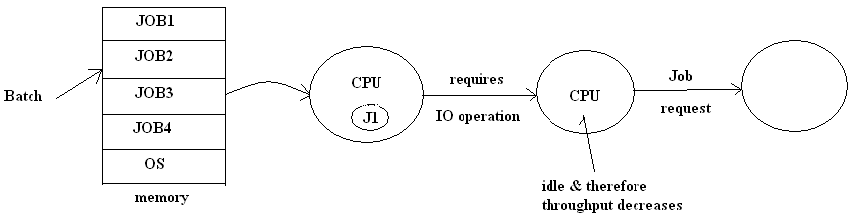 Throughput- no. of jobs executed per unit time( per second) is called as throughput.
Jobs are placed into main memory in orfer to execute the jobs in non neumann arch or stored program concept.
In Batch operating system, FIFO is used i.e only second job will go to execute if first would complete.
CPU idleness-
Throughput- no. of jobs executed per unit time( per second) is called as throughput.
Jobs are placed into main memory in orfer to execute the jobs in non neumann arch or stored program concept.
In Batch operating system, FIFO is used i.e only second job will go to execute if first would complete.
CPU idleness-  CPU utilisation
2. Multiprogramming operating system- In order to remove the limitation of batch operating system, this comes.
CPU utilisation
2. Multiprogramming operating system- In order to remove the limitation of batch operating system, this comes.
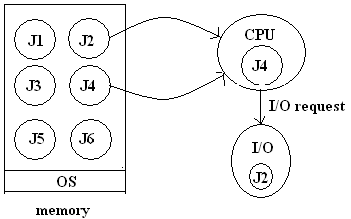 If J2 goes to input/output operation then J4 comes & executed.
This will increase-
If J2 goes to input/output operation then J4 comes & executed.
This will increase-
- CPU utilisation
- Throughput
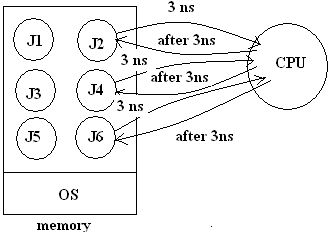 switching is done between jobs. J2 is firstly executed upto 3ns, then switch back into memory & J4 comes to execute & so on.
e.g. listening songs and writting in notepad simultaneously is multitasking operating system.
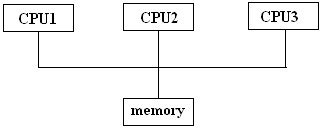
4. Multiprocessor operating system- more tham one processor or CPU ina single system sharing a common memory.
switching is done between jobs. J2 is firstly executed upto 3ns, then switch back into memory & J4 comes to execute & so on.
e.g. listening songs and writting in notepad simultaneously is multitasking operating system.
4. Multiprocessor operating system- more tham one processor or CPU ina single system sharing a common memory.
 Advantages-
- Increased throughput- if we have complicated and huge no. of applications then we will select muliprocessor operating system.
- Reliability- If one job is failed then other jobs can be executed wiyh remaining CPUs. Reliabilty in technical terms is Fault Tolerant System meaning that we are accepting the fault.
- Economical
 FUNCTIONS OF OS-
- Process management(process creates, process scheduled)
- Memory Management(allocation & deallocation)
- File Managemen(file creation, deletion)
- Device Management(structure of hard disk)
- Network Management(structure of tape)