The Network Model
The network model uses the plex structure as its basic data structure. A network is a directed graph consisting of nodes connected by links or directed arcs. The nodes corresponds to record types and the links to pointers or relationships. All the relationship are hardwired or pre-computed and build into structure of database itself because they are very efficient in space utilization and query execution time.
The network data structure looks like a tree structure except that a dependent node which is called a child or member, may have more than one parent or owner node.All figure shows the network model –
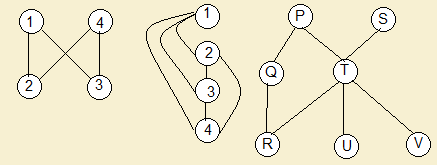 |
| Figure 1 |
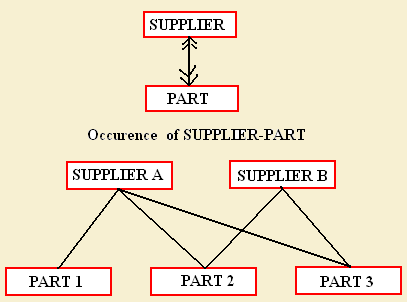
A diagram called as Bachman Diagram is used to represent a network data structure. The nodes in the network are replaced by rectangles that represent records and links are shown by lines connecting the rectangles.
A plex structure with two record types is shown-
 |
| Figure 2 |
Operations on network model
- Insertion- In the above figure, it is clear that a new part or supplier can easily be inserted.
- Deletion- For deletion only link is to be removed and no information will be lost. For example, to remove PART 2, we delete the connector line between suppliers.
- Updation- Updation is also easy, for example, suppose SUPPLIER B supplies PART 1 in place of SUPPLIER 2, so, updation will be successfully done by changing the link of SUPPLIER B from PART 2 to PART 1.
Advantages :
- Easy access to data.
- Flexible
- Efficient
- This model can be applied to real world problems, that require routine transactions.
Disadvantages :
- complex to design and develop.
- Extra memory is required for storage of pointers
- Performance is infexible and difficult to use.
- Operation and maintenance are time consuming and expensive for large databases.
]]>