C++ Relational Operators –
In Relational Operators, relational refers to the relationships that values or operands can have with one another arn are used to determine the relation among different operands.
C++ provides 6 types of Relational operators for comparing numbers and characters –
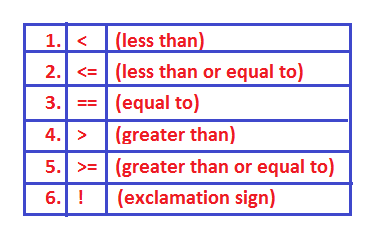 The relational expression will gives boolean value 1, if the comparison between the two operands is true,
otherwise, it will give boolean value 0 . For example,
The relational expression will gives boolean value 1, if the comparison between the two operands is true,
otherwise, it will give boolean value 0 . For example,
| M |
N |
M<N |
M<=Q |
M==Q |
M>Q |
M>=Q |
M!=Q |
| 0 |
1 |
1 |
1 |
0 |
0 |
0 |
1 |
| 1 |
0 |
0 |
0 |
0 |
1 |
1 |
1 |
| 3 |
3 |
0 |
1 |
1 |
0 |
1 |
0 |
| 2 |
6 |
1 |
1 |
0 |
0 |
0 |
1 |
Following table summarizes of relational operators in C++
| S.no |
Operators |
Name |
Example |
Description |
| 1 |
> |
Greater Than |
6>5 =15>6 =0 |
Returns Boolean truth value(0 for false and 1 for true) |
| 2 |
< |
Less than |
6<5 =05<6 =1 |
Returns Boolean truth value |
| 3 |
>= |
Greater than equal to |
6>=5 =16<=5 =0 |
Returns Boolean truth value |
| 4 |
<= |
Less than equal to |
6<=5 =06>=5 =1 |
Returns Boolean truth value |
| 5 |
== |
Equality |
6==5 =06==6=1 |
Returns Boolean truth value |
| 6 |
!= |
Not equal to |
6!=5 =16!=6 =0 |
Returns Boolean truth value |
Some Important Notes about Relational Operators :
 * (=) & (==) operator - The (=) operator is used to assign the values and   therefore called as assignment operator. The (==) operator is used for    comparing the (LHS) and (RHS) values.

 *Avoid equality comparisons on floating point numbers - because they are
  not as exact as integer arithmetic

* Avoid comparing signed and unsigned values- as the compiler will treat
  signed value as unsigned. If signed value is negative, it will be
  treated as unsigned value.
  For example, a=2 , b=-6 ; If we have the expression (a<b)
  then, the expected result will be 0 (boolean zero), But the produced
  result will be 1 (boolean one).

  Solution for comparing signed and unsigned values : Explicit Type
  casting (conversion of data type to another one explicitly) - The above
  expression can be cast as follows :
         ((signed int) a < b )  Produced result 0 .
Example of C++ program for Relational Operators –
#include<iostream.h>
int main()
    {
    int x, y;
    cout<<"enter the value of x and y = \n"
    if (x == y)
        cout<<"\n x is equal to y");
    else if (x > y)
        cout<<"\n x is greater than y ");
    else
        cout<<"\n x is smaller than y ");
    return 0;
    }
Output examples:
Enter The value of x and y=     //1st example
40
30
x is greater than y
Enter The value of x and y=    //2nd Example
10
30
x is smaller than y
Enter The value of x and y=   //3rd example
30
30
x is equal to y
]]>