//
Database Operations and Constraint Violations – The Insert Operation
The basic Database operations performed on a relation are –- Insert Operation – The insert operation is used to insert a new tuple(s) on relations.
- Delete Operation – The delete operation is used to delete the tuple(s).
- Update or Modify Operation – The update operation is used to change/update the values of some attributes in existing tuples.
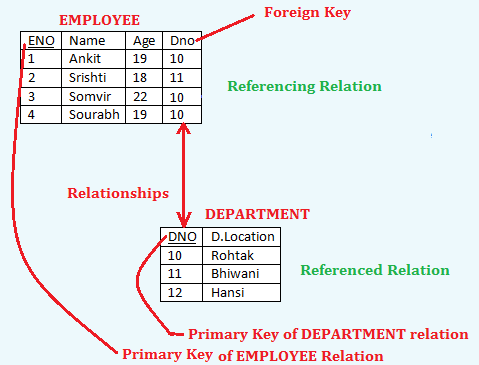 Some Basic Points about the Figure –
- Here, ENO is a Primary Key and DNO is a Foreign Key in EMPLOYEE relation.
- Table that contain candidate key is called referenced relation and
- The table containing foreign key is called referencing relation.
- So, the relation DEPARTMENT is a referenced relation and
- The relation EMPLOYEE is a referencing relation.
The Insert Operation :
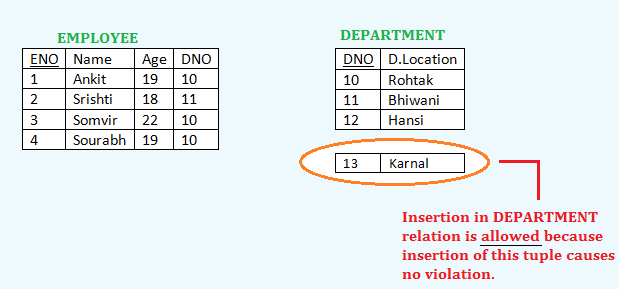
- Insertion in a Referenced Relation (DEPARTMENT) –
If we insert a tuple in the referenced relation , then it causes no violation.
For example, Insertion of <13, ‘Karnal’> in DEPARTMENT relation is allowed because insertion of this tuple causes no violation.
- Insertion in a Referencing Relation (EMPLOYEE) –
The insert operation in a referencing relation can violate any of four types of constraints –
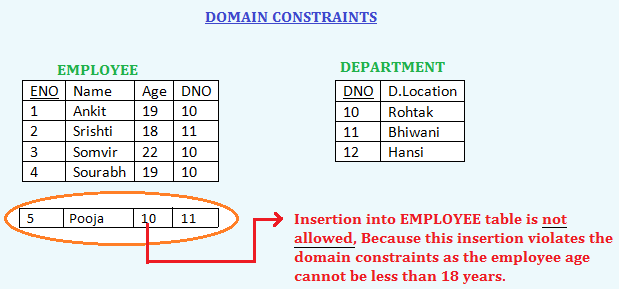
- Domain Constraints –
Insertion of the value <5, ‘Pooja’, 10, 11> into EMPLOYEE table is not allowed, Because this insertion violates the domain constraints as the employee age cannot be less than 18 years.
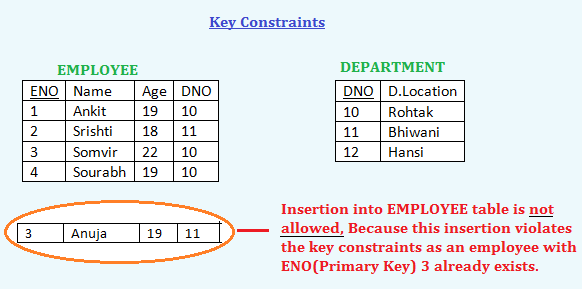
- Key Constraints –
Insertion of the value <3, ‘Anuja’, 19, 11> into EMPLOYEE table is not allowed, Because this insertion violates the key constraints as an employee with ENO(Primary Key) 3 already exists.
- Entity Constraints –
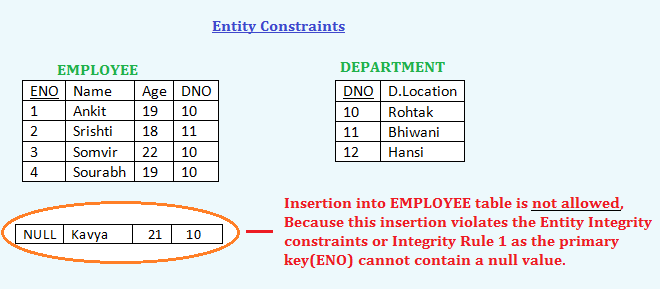
Insertion of the value <NULL, ‘Kavya’, 21, 10> into EMPLOYEE table is not allowed, Because this insertion violates the Entity Integrity constraints or Integrity Rule 1 as the primary key(ENO) cannot contain a null value.
- Referential Integrity Constraints –
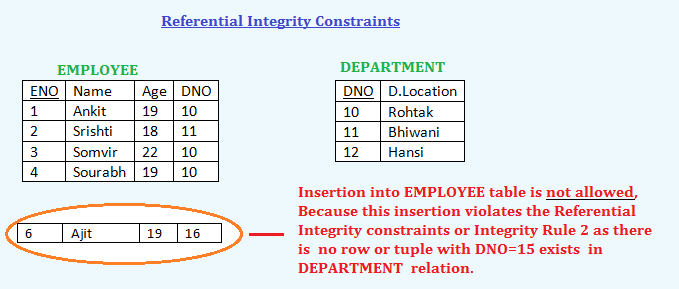
Insertion of the value <6, ‘Ajit’, 19, 16> into EMPLOYEE table is not allowed, Because this insertion violates the Referential Integrity constraints or Integrity Rule 2 as there is no row or tuple with DNO=15 exists in DEPARTMENT relation.
- Domain Constraints –
Insertion of the value <5, ‘Pooja’, 10, 11> into EMPLOYEE table is not allowed, Because this insertion violates the domain constraints as the employee age cannot be less than 18 years.