Bitwise Operators in C++ As the name says, bitwise operators are used to perform operations on bits. Bit is the smallest unit memory. A bit represents 2 unique combinations of binary numbers.
- 0 (boolean zero)
- 1 (boolean one)
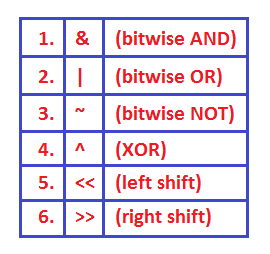 The Truth table for Bitwise Operators will be –
| x | y | x|y | x & y | x ^ y |
| 0 | 0 | 0 | 0 | 0 |
| 0 | 1 | 1 | 0 | 1 |
| 1 | 0 | 1 | 0 | 1 |
| 1 | 1 | 1 | 1 | 0 |
(o & p)  AND Operator Working
   o=  0 0 0 1 1 1 1 1    (31 in decimal)
   p=  0 0 0 1 0 1 0 1    (21 in decimal)
       ----------------
(o&p)= 0 0 0 1 0 1 0 1
       ----------------
(o | p)  OR Operator Working
    o= 0 0 0 1 1 1 1 1    (31 in decimal)
    p= 0 0 0 1 0 1 0 1    (21 in decimal)
       ----------------
(o|p)= 0 0 0 1 1 1 1 1
       ----------------
(o ^ p)  XOR Operator Working
    o= 0 0 0 1 1 1 1 1    (31 in decimal)
    p= 0 0 0 1 0 1 0 1    (21 in decimal)
       ----------------
(o^p)= 0 0 0 0 1 0 1 1
       ----------------
(~o)  Negate/Bitwise Not Operator Working
 x= 0 0 0 1 1 1 1 1    (31 in decimal)
~x= 1 1 1 0 0 0 0 0
Example of C++ program for Bitwise Operators –
#include <iostream.h>
int main()
    {
    int o = 31,p = 21,AND,OR,XOR,NOT;
    AND = (o&p);
    OR  = (o|p);
    NOT = (~o);
    XOR = (o^p);
    cout<<"AND Operator value = "<<AND <<endl;
    cout<<"OR Operator value = "<<OR <<endl;
    cout<<"NOT Operator value = "<<NOT <<endl;
    cout<<"XOR Operator value = "<<XOR <<endl;
    return 0;
    }
Output –
AND Operator value = 21
OR Operator value = 31
NOT Operator value = -32
XOR Operator value = 10
Explanation of Output :
21 = 0 0 0 1 0 1 0 1
31 = 0 0 0 1 1 1 1 1

and operator will result 0 0 0 1 0 1 0 1 = (21)10
or operator will result 0 0 0 1 1 1 1 1 = (31)10
NOT operator will result 1 1 1 0 0 0 0 0 = (-32)10
XOR operator will result 0 0 0 0 1 0 1 0 = (10)10
]]>