Architecture of DBMS – The architecture of DBMS is divided into 3 general levels :
- Internal view/Physical Schema
- Conceptual Schema
- External Schema
Data Independency –
First of all, we should know about Data Independency. Data Independency is the ability to use the database without knowing the representation details. To provide data independency, there should be atleast two levels of abstraction:- Logical Data Independence – means that the overall logical structure of data may be changed without changing the application programs.
- Physical Data Independence – means that the physical layout and the organisation of data may be changed without changing the overall logic structure of data or the application programs
Why there is requirement of data independency –
- To allow the DBA to make changes in the content, location, representation and organisation of a database without causing the reprogramming of application programs which use the database.
- To allow the supplier of data processing equipment and software to introduce new technologies without causing reprogramming of customer’s application.
- To facilitate data sharing by allowing the same data to appear to be organised differently for different application programs.
- To simplify application program development in particular, to facilitate the development of programs for interactive database processing.
- To provide the centralization of control needed by the database administrator(DBA) to ensure the security and integrity of the database.
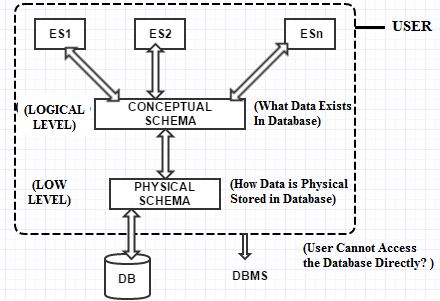 Physical schema: Metadata about the physical data in DB.
CREATE TABLE STUDENT
(
   ----------
   ---------
   ----------
);
STUDENT FILENAME
Details of Database Files stored in Physical Scheme.
Physical schema is maintained by s/w & the user is not allowed to interface. This level is closest to physical storage, which is concerned with – in which the data is actually stored. External Schema : This level is closed to the users, and is concerned with – in which the data is viewed by individual viewers. Conceptual Schema:
- It is the representation of entire contents of database
- If we access the data through conceptual scheme, then we can access all the data. To restrict the data we provide security through external scheme.
- Hide the physical details.
- Student (SID, SNAME, ……)
- We don’t know how the data exists.
- DBMS is an interface b/w user & database.
| Previous | Home | Next |
| Execution Steps of DBMS | ER MODEL (Entity Relationship Model) |
]]>