Database and DBMS Introduction
Database
Database is the collection of interrelated data. or collection of related information stored so that it is available to many users for different purposes. The content of database is obtained by combining data from all the different sources in an organisation.Database Management System (DBMS)
DBMS is a software used to manage and access the database in efficient way. It manages the data in a database. There are various DBMS available – For example –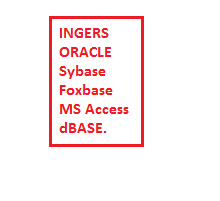
Some related terms used in DBMS –
Data : is the raw facts and figures. It is represented with the help of characters like alphabets(A-Z), digits(0-9) and special characters (+,-,/,*,<,>,= etc.) Data Item (Field) : Set of characters which are used to represent a specific data element. For example, Name of student in a class is represented by a data item, say name. Record : A collection of related items. Example a Student record containing name, age, DOB, Fathers name, mothers name, rollnumber, marks, etc. File : is a collection of related records. For example, Student file.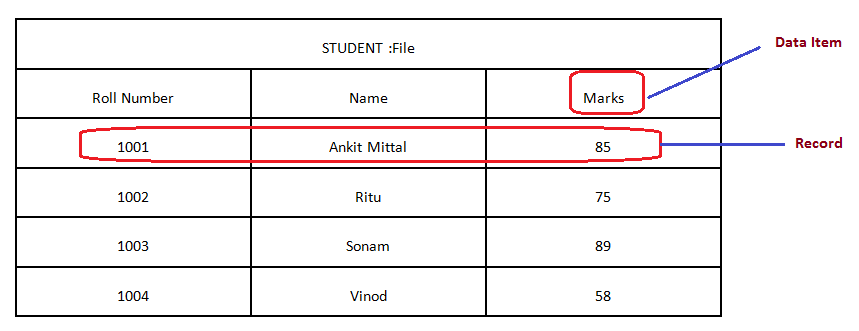 Information : is organised or classified data so that it has some meaningful values. It is the processed data, which has the following characteristics :
- Timely
- Accurate
- Complete and
- Given to the right persons
| Basis | Data | Information |
| Meaning | Raw facts and Figures | Processed data so that it has some meaningful values. |
| Example | Test Score of each student | Average Score of a class |
 |
||
Database Design Steps
- Requirements Analysis
- Conceptual Modelling (ER Model)
- Logical Modelling (Relational Model)
- Schema Refinement (Normalization)
Types of Databases
- OLTP – Online Transaction Processing –
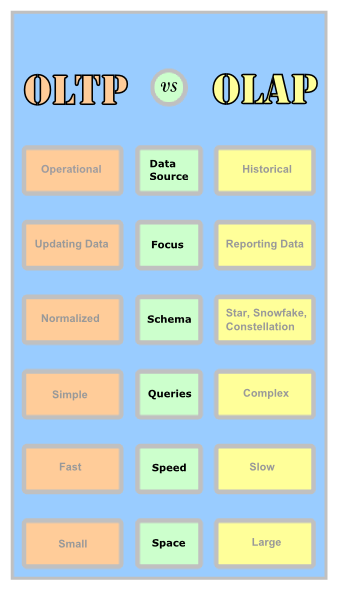
- The main focus for OLTP systems is updating data to put on very fast query processing, maintaining the integrity of data in multi-access environments.
- The effectiveness of OLTP systems is measured by number of transactions per second.
- It is simply called as Database.
- The main operations performed on OLTP are Read and Write.
- Use of simple SQL
- OLAP – Online Analytical Processing –
- The main focus of OLAP systems is reporting data.
- The effectiveness of OLAP systems is measured by response time.
- OLAP applications are widely used by Data Mining Techniques.
- It is also called as Data Warehousing.
- The main operations performed on OLTP are Read only.
- Use of Complex SQL (Joins etc.)
Difference between OLTP and OLAP systems
Another Classification of Databases
- Commercial Databases : Inventory Control System, Library, Student Information System
- Multimedia Databases : Voice, Video Clips, Images
- Temporal Databases : Attaching time aspect to data. For example, Railway Reservation.
- GIS (Geographical Information System) Databases : To give ways to reach destination. For example, Route Map, Google Earth
- Distributed Databases : Web Environment (Consistency is very high) ⇒ Concurrency and Transactions
- Deductive Databases : Rule Based : (A=B, B=C ⇒A=C), If we buy one thing, then there is chance of buying the other.
- Document Databases : Google, Content Information System
- Active Databases : Flooded with Triggers
- Web Databases : Any database can become a web database, if it is available in web environment
Different Types of DBMS
- Relational DBMS
- OR DBMS (Object Relational DBMS) : example oracle i. For RDBMS, we added object oriented principles
- OD DBMS (Object Oriented DBMS) : For object oriented, we added relational principles
| Previous | Home | Next |
| DBMS vs File System and Disadvantages of File System |
]]>