Type Conversion and Type Casting in C++
Both Type conversion and Type casting in C++ are used to convert one predefined type to anther type.
Type Conversion is the process of converting one predefined type into another type.
and type Casting is the converting one predefined type into another type forcefully.
Need Of Type Conversion and Type Casting in C++-
An Expression is composed of one or more operations and operands. Operands consists of constants and variables. Constants and expressions of different types are mixed together in an expression. so they are converted to same type or says that a conversion is necessary to convert different types into same type.
C++ facilitates type conversion into 2 forms :
Implicit Type Conversions :
Implicit Type Conversion is the conversion performed by the compiler without programmer’s intervention.
It is applied, whenever, different data types are intermixed in an expression, so as not to loose information.
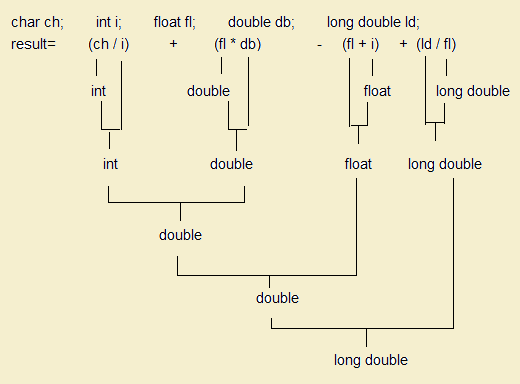
The C++ compiler converts all operands upto the type of the largest operand, which is called
type promotion.
Usual Arithmetic Conversions are summarized in the following table –
| StepNo. |
If either’stype of |
Then resultant type of other operand |
Otherwise |
| 1 |
long double |
long double |
Step 2 |
| 2 |
double |
double |
Step 3 |
| 3 |
float |
float |
Step 4 |
| 4 |
— |
integral promotion takes place followed by step 5 |
— |
| 5 |
unsigned long |
unsigned long |
Step 6 |
| 6 |
long int ant the other is unsigned int |
(i) long int (provided long int can represent all values of unsigned int) |
Step 7 |
| (ii) unsigned long int(if all values of unsigned int can’t be represented by long int) |
Step 7 |
| 7 |
long |
long |
Step 8 |
| 8 |
unsigned |
unsigned |
Both operandsare int |
The step 1 and 2 in the above table will be read as –
Step 1: If either operand is of type
long double, the other is converted to
long double.
Step2 : Otherwise, if either is of type
double, the other is converted to
double.
After applying above arithmetic conversions, each pair f operands is of same type and the result of each operation is the same as the type of both operands.
Example :
 Explicit Type Conversion :
Explicit Type conversion is also called type casting. It is the conversion of one operand to a specific type. An explicit conversion is a user defined that forces an expression to be of specific type.
Syntax : (type) expression
Example : float(a+b/5) ; This expression evaluates to type float.
Problem in Explicit Type Conversion : Assigning a value of smaller data type to a larger data type, may not pose any problem.
But, assigning a value of larger data type to smaller type, may poses problems. The problem is that assigning to a smaller data type may loose information, or result in losing some precision.
Conversion Problems –
| S.no |
Conversion |
Potential Problems |
| 1 |
Double to float |
Loss of precision(significant figures) |
| 2 |
Float to int |
Loss of fractional part |
| 3 |
Long to int/short |
Loss of Information as original valuemay be out of range for target type |
Type Compatibility –
In an assignment statement, the types of right types and left side of an assignment should be compatible, so that conversion can take place. For example,
ch=x; (where ch is of char data type and x is of integer data type)
How and Why Information is loose ?
what is Big Endian ?? ⇒ refer to the link Click here
since the memory representation in
Big-Endian, Let
int x=1417;
ch=x;
now, x will be 00000101 10001001 in binary.
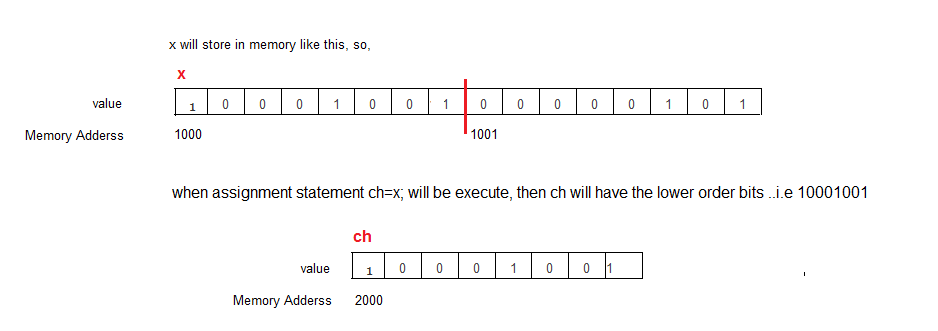
So, the information i.e. the value stores at address 1001, will be lost after assigning an integer variable value to a character variable
Example of C++ program for type casting –
#include <stdio.h>
int main ()
{
    float x;
    x = (float) 7/5;
    cout<<"x="<<x;
}
]]>